I spent a lot of my own childhood rambling alone in the forest of the Kenai Peninsula in Alaska where I grew up. My parents would take my sister and me on weeks-long camping trips for the sockeye salmon season in mid-July to early August. While they were fishing, I was pretty much left to my own devices. While my sister ran around with the other river rat kids, I would often slip away into the forest. There, nestled in the embrace of a Sitka spruce and on a cushion of velvety soft moss, I would daydream or sketch or whittle or write silly stories or sing the latest pop song I’d heard on the radio to myself.
At nine or ten years old, I stumbled into an experience that became a touchstone for how I understand magic in the natural world. I was at my favorite small clearing at the time of day when the sun’s rays, fierce and bold this time of year in these long days of Alaska’s midnight sun, would soften as they pierced the canopy into the golden, swirling motes of forest dust that danced in the sunbeams. Here, I liked to pretend I was in a spotlight on a stage, the birch trees and wild roses my captive audience, as I sang my own rendition of Footloose or Raspberry Beret.
It was during one of my “performances” when I was suddenly surrounded by a small, squabbling flock of the tiniest Winter wren fledglings. And the next thing I knew, they were all over me – in my hair, on my sleeve, my shoulder, clinging to the string of my hoodie while they shouted birdie obscenities at one another. And then, as quickly as they came, they chattered away, zigging and zagging off into the foliage. That fleeting encounter imprinted itself so deeply that wrens have followed me ever since.
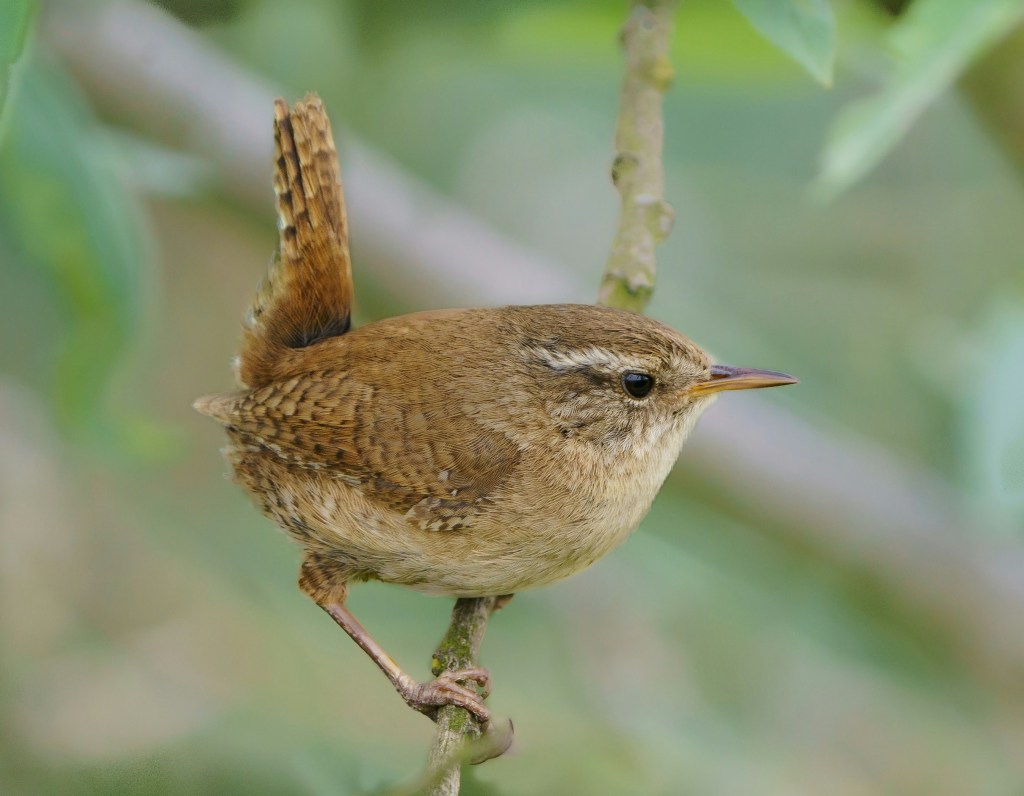
This tiny bird is only about four inches long, but has had an outsized place in my life. If you hear a mighty voice coming from the brush close to the ground on your next hike, look out for a puffy little kiwi fruit that is dark brown with white speckles along its wing, an arched white eyebrow giving it a judgmental vibe, and a jaunty tail that stays cocked upright, the way dogs’ ears do when they hear something interesting. I still see Winter wrens nearly every time I go outside in the Pacific Northwest. Now known as Pacific wrens west of the Rockies, they find me on hiking trails, camping trips, in city parks, or even once or twice in my urban backyard. There was even a stormy early summer day when I was solo backpacking in the Colonel Bob Wilderness near Quinault in my early twenties when another group of fledglings made their way into the open door of my tent to take cover from the downpour. I was reading in my sleeping bag that afternoon, waiting out the squall, when that little flock of gatecrashers flitted about in that bumbling, drunken way that teenage birds do when they first leave the nest and are learning to work their wings.
These close encounters can’t be coincidence, can they? Do I notice them more because of that childhood moment? Or is there something more mysterious at play, a thread weaving me to these diminutive birds across time and place? Nature has a way of presenting itself in moments that feel enchanted, as if unseen forces are at work.
Across cultures and centuries, people have turned to stories to make sense of the mysteries of the natural world. The wren, for instance, appears in traditions from Europe to the American Southwest. In Aesop’s fables, the wren is crowned “king of the birds,” a symbol of cleverness outwitting strength. The Druids believed wrens to be sacred messengers, whispering hints of the future on their wings. Among the Pueblo tribes, catching sight of a wren is said to bestow courage. Such stories speak to the same awe and wonder I felt that afternoon in the Alaskan forest – the sense that these tiny creatures carry with them something larger than themselves, something bordering on the mystical.
Just as wrens slip unexpectedly into my life, folktales remind us that nature is never only background. It is alive, magical, and bound to us in ways we cannot always explain. Since the dawn of civilization, people have crafted such tales as a reminder that even in the smallest creatures, there is an outsized magic, and that the world still holds mysteries worth telling stories about.

 The Mindful Naturalist
Leave a comment