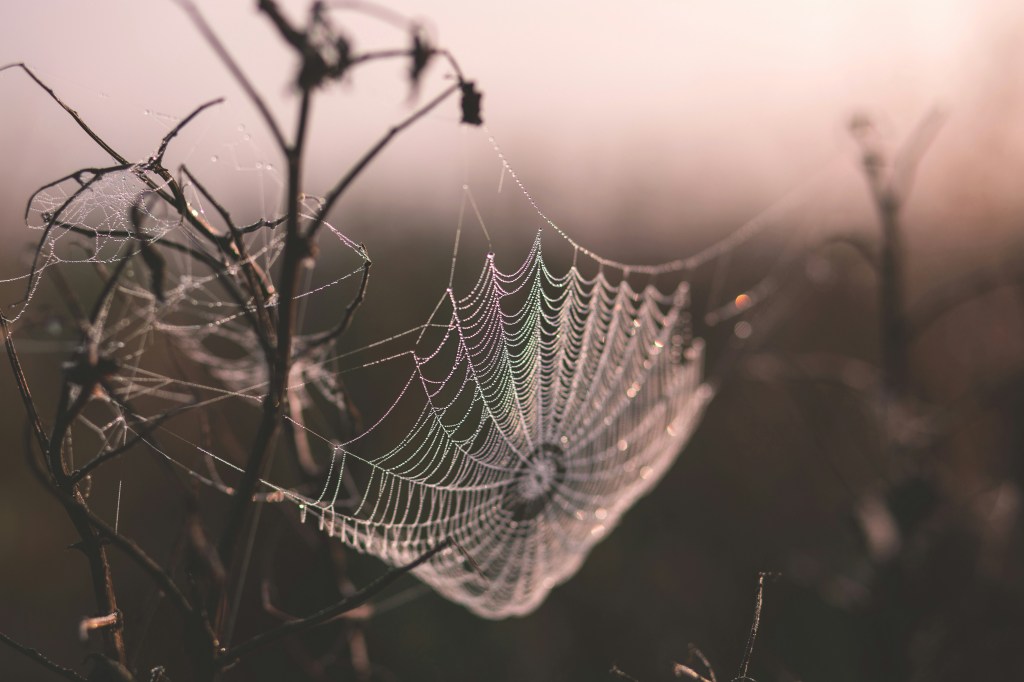
Background: Have you ever seen how morning dew turns a spider’s web into a necklace of diamonds, each drop sparkling in the light? In fall and winter, when the trees are bare, we can suddenly spy these delicate designs; secret traps of silk that would be nearly impossible for a wandering insect to escape. Winter’s Web is your chance to step inside that magic. With ropes stretched between trees like giant silver threads, you and your kids become nimble ninjas, slipping and sliding, ducking and twirling, trying not to brush against the web. Can you make it through without getting caught?
This game was adapted from one of my favorite resources: A Year of Forest School: Outdoor Play and Skill-building Fun for Every Season by Jane Worroll and Peter Houghton. I highly recommend checking it out for many more thoughtful and delightful outdoor activities.
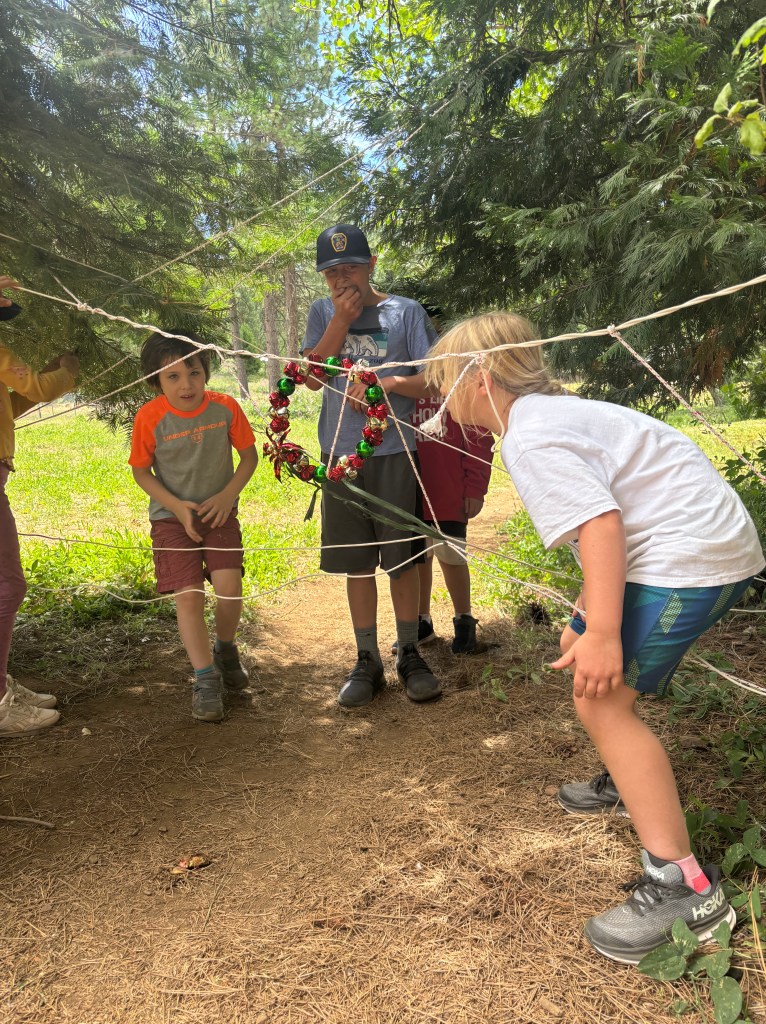
Materials: A forest or other outdoor space with trees to tie rope to. Three 60 ft lengths of paracord, string, or rope. Shorter lengths make a less complicated web for younger naturalists. This activity is best for ages 3 and up. I like to add a jingle bell or bear bell to the web to make it clear when a line is touched.
Activity:
Choose an area in the woods where you can find low hanging branches that kids can easily reach. Allow the kids to weave and tie the cord around the trees to create a giant spider’s web, with your help with knots if needed. The more intricate or complicated the better! This web should be complicated horizontally and vertically so that players can move through it several times in unique ways.
Give the players three “lives” to get through the web without touching the ropes. You can hang jingle bells or anyone who wants to watch, but not play, can be the rope buzzer who makes a noise if a player touches a line. All the player’s eyes will help you watch out for insects caught in the web!
Players have to make it through the web without touching it with any part of their body. If they touch it, the web buzzes and they lose a life and they must go back and join the end of the line. On the first time you go through, you can use all your limbs to help you duck, twist, and balance. But, on the second time through, you can use only three of your limbs to help you. On the last go through, you’re down to two limbs at a time. This is where the game becomes the most fun! If older kids are finding it too easy, you can always add a time limit or make it a race with two players or groups going through it at the same time to add the extra elements of challenge.
Closing questions: Which part of constructing the web was easy? Which part was hard? Can you think of any way to improve the web?
Extensions:
A spider’s web isn’t just a decoration; it’s a lifeline! It’s their home, their hunting ground, and their way to survive. Tiny flying or crawling creatures that accidentally wander into the sticky strands become a meal for the spider. In this way, spiders are secret superheroes of the ecosystem, keeping pesky insects under control. And they’re not just feeding themselves. Spiders feed birds, toads, shrews, and even other spiders or insects too. And here’s a fun fact: for its size, spider silk is stronger than steel! That’s some seriously super-strong thread.
Web Sketching: Go outside and look for real spider webs. Try to sketch the patterns you see or photograph them in the morning dew. Notice how each web is different – how some are tall, some are wide, and some have sticky strands that glisten in the sun.
Field Study: Answer the question, “How does the location of a spider’s web affect the number and types of insects that get caught?”
To answer this question, observe a variety of webs in different spots (sunny vs. shady, high vs. low, near flowers vs. bare ground). Count and identify insects caught over a period of time. Compare patterns and think about why some webs might be more successful than others.
Other field study variations could be:
“Which types of spider webs are most common in my neighborhood?”
“Does the time of day affect how many insects a spider catches?”
This game was adapted from one of my favorite resources: A Year of Forest School: Outdoor Play and Skill-building Fun for Every Season by Jane Worroll and Peter Houghton

 The Mindful Naturalist
Leave a comment