Background:
So, what is a solstice, anyway? How is it different from an equinox? Simply put, these are the two types of astronomical events that cause the seasons. The Earth takes 365 days to move around the sun, but it doesn’t have perfect posture while it makes its way along its orbit. The Earth has a tilt! It leans over at about 23.5 ° away from the center line, or the axis, which is like an imaginary stake that runs through the center of the Earth and pokes out on the North and South poles. Picture a candy apple with the stick running through the center. Now imagine that it’s spinning just like a top, and as it spins it leans a little to one side. It’s a lot like that. That tilt means that during the Earth’s journey around the sun, sometimes the North Pole is tilted toward the sun and sometimes it’s tilted away from the sun.
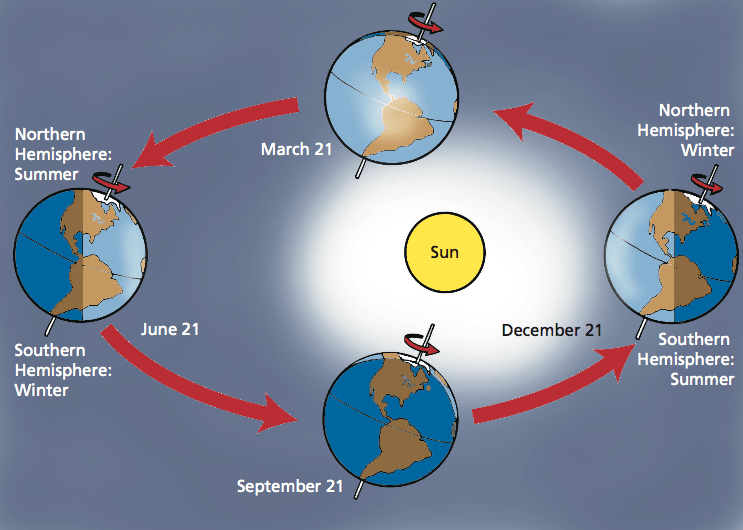
Image: Smithsonian Science Education Center
Between March 21 and September 21, the Northern Hemisphere is tilted toward the Sun and has spring and summer. During that same time, the Southern Hemisphere is tilted away from the Sun and has fall and winter. The equator stays warm all year round and the hours of daylight and night remain relatively equal.
The day of the year with the most daylight (in the Northern Hemisphere, where those of us in the PacNW live) is the Summer Solstice, and it’s when the North Pole is tilted the most toward the sun. The day with the least daylight, the Winter Solstice, happens when the North Pole is tilted the furthest away from the sun on its journey. The points in between are the Equinoxes; the days when the amount of daylight and night are just about equal. (Get it… equal, equinox? Literally “equal night”) The Vernal Equinox, around March 21, marks the beginning of Spring and the Autumnal Equinox, around September 21, marks the beginning of Fall.
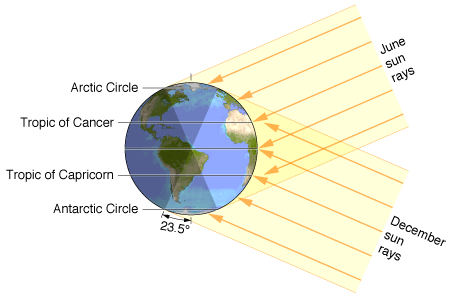
Image: Weber State University’s Understanding Astronomy Page
The amount of sunlight available is a marker for plants and animals to prepare for the dormancy of Winter or for the growing season of Summer. That might mean that you notice ducks and geese flying overhead in migration to their breeding grounds in the north during the Springtime. You’ll notice the leaves changing colors in the Autumn as trees take in all the nutrients from the leaves to store them away in their roots to sustain them through the Winter.
Materials:
Measuring tape, a blank page from your nature journal to record your data, calendar or app to remind yourself to repeat this activity at the other solstice and at the equinoxes. (Make a note to collect your data at the same time as today!)
Activity: Measuring shadows
Create a page in your nature journal dedicated to this activity. Use the weather app on your phone, or use a website like www.sunrisesunset.com to look up the time of the sunrise and sunset for your location and how many hours of daylight that you’ll experience today. Record this information in a page in your nature journal so that you can come back to it at the spring equinox, summer solstice, autumn equinox, and reflect on your findings.
Measuring Shadows: Decide on an object that casts a shadow near where you live. Choose something that will not change over time – a flagpole, fence post, a tree – because you’ll be observing this throughout the year. Use your measuring tape to measure the length of the shadow cast by your object and record your findings in your journal. You’ll repeat this activity again at the spring equinox, summer solstice, and autumn equinox to compare your results!
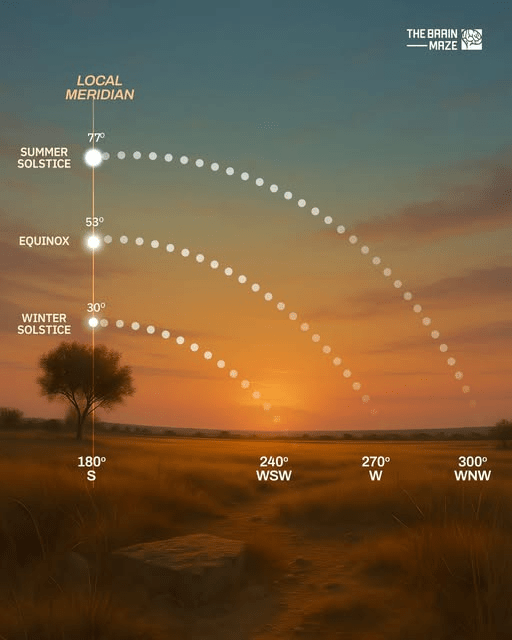
Image: The Brain Maze
This activity will be your way of tracking the sun’s path across the sky. The image shows the path of the Sun across the sky during three key times of the year: the summer solstice, equinox, and winter solstice. I love this graphic because it highlights how both the Sun’s arc and its setting point change with the seasons.
Extensions:
Want to learn more? Here are some more fun activities that you can try at home to keep exploring!
Create an Earth-Sun model: Use a foam ball or ping pong ball on a chopstick to represent the Earth and its 23.5 ° tilt. Shine a flashlight (the sun) on it to show how the Northern Hemisphere receives less direct sunlight during the winter solstice, resulting in shorter days.
Observe the sun’s path: Go outside at the same time each day and to the same place in your neighborhood for a whole month. Take a photo of the scene capturing the position of the sun. You can print these or make a digital collage to notice its changing position and height in the sky, demonstrating the effect of Earth’s tilt. I know you know this already, but don’t look directly at the sun!
Engineering Challenge: Explore the science of light. Imagine that on this shortest day of the year, the power has gone out. Your family only has the batteries to power one flashlight. Your task is to tackle an engineering challenge of designing a device to spread the light of one flashlight to illuminate an area wide enough for your family to make dinner together or play a board game comfortably.
To complete the build, provide these materials (or similar):
- Scissors
- Clear tape
- Paper Straws
- Index cards, cardstock, or paper plates
- Paper cups
- Paper bowls
- Aluminum foil
- Pipe cleaners
- Binder clips
- Recyclables (clear plastic packaging, cardboard tubes, etc.)
- Screwdriver or sharp pencils for poking holes
- Water
- Your Sense of Adventure

 The Mindful Naturalist
Leave a comment