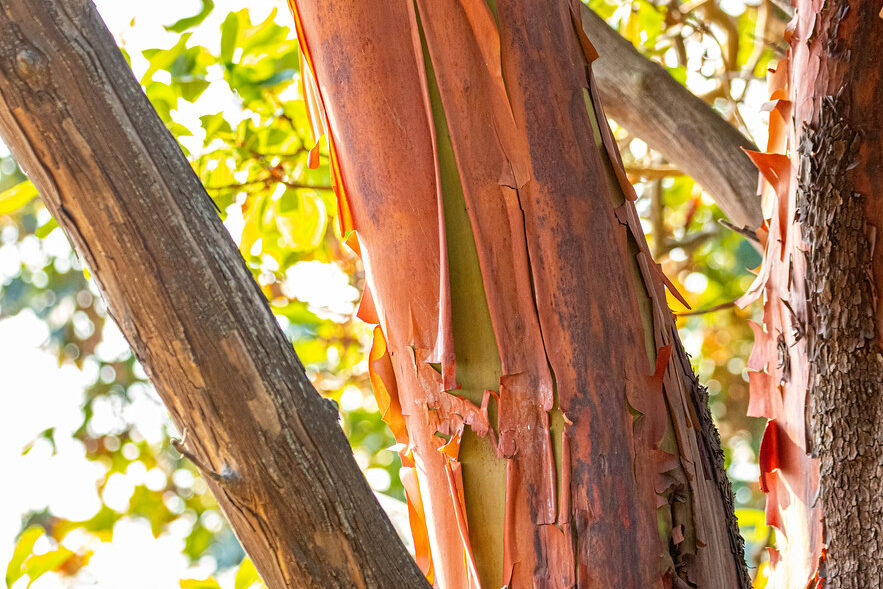
As the year turns, we often feel pressure to make clean breaks and bold resolutions. The Pacific madrone offers a gentler model.
Pacific Madrone, The Rebel Tree
Deciduous trees grow new leaves in the spring, then drop them in the fall. Coniferous trees are evergreen and hold onto their needles all year. Those are the tree rules.
Of all the evergreens in the Evergreen State, the Pacific Madrone has held a special place of fascination for me because it breaks these rules. This is a tree that instead of dropping its leaves in the fall, it peels its bark in mid-summer! This quirk has always resonated with me as I, too, have never tended to be all that conventional.
So, why do they do it? The truth is that scientists don’t really know.
The Refrigerator Tree
Arbutus menziesii is a tree that goes by many names. Another way the madrone breaks the rules is with its bark, or rather, its “skin”. As the tree grows, it sheds this outer layer each summer, peeling away to reveal a smooth, fresh surface beneath. Over the course of a few weeks, that new layer slowly deepens into the madrone’s familiar, burnished red. In this way, the madrone behaves less like a typical tree and more like a reptile, molting as it grows. Like a reptile, it is also “cold-blooded.” Rest your palm against the trunk, and even on the warmest summer day, the tree will feel cool and alive beneath your hand.
Madrones are in the Ericaceae family, which also includes many other Pac NW favorites like rhododendrons, manzanita, salal, huckleberry, and blueberry. Adding to the list of the outstanding and the noteworthy, its relatives include oddities such as the nonphotosynthetic plants Indian pipe and Snow plant.
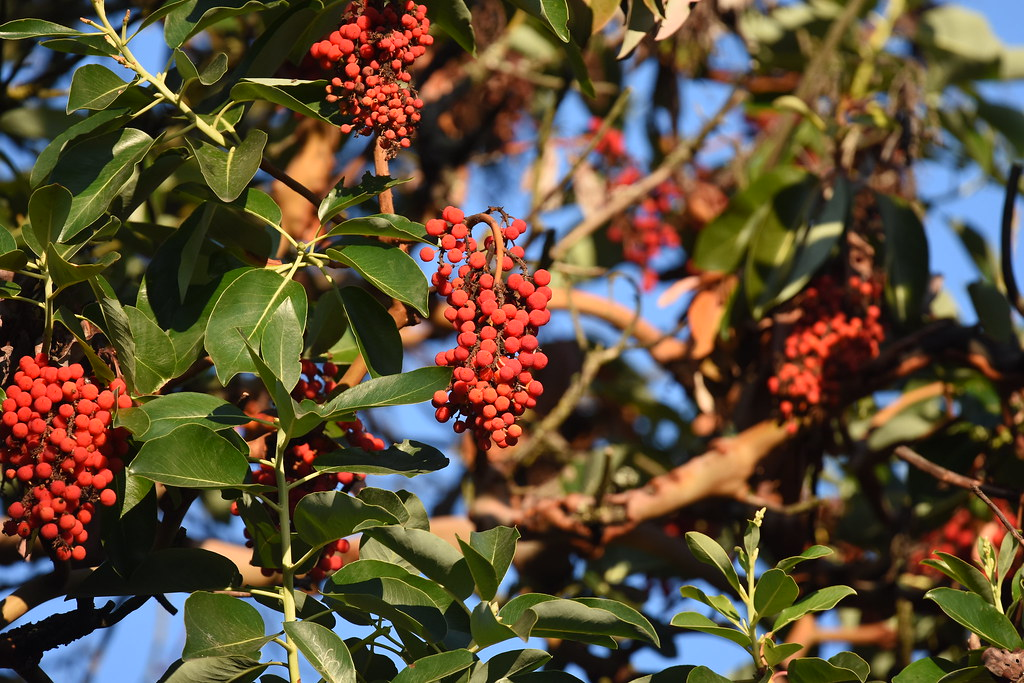
Ripe madrone berries Photo: Green Seattle
The Strawberry Tree
Following the flowers of spring, the fruit sets into berries that will gradually turn yellow, then a bright orange-red color. This is the source of one of the tree’s nicknames, “strawberry tree”. Since its berries ripen from early autumn and last through December, it is an important source of food for wildlife in the Pacific Northwest. These fruits are a favorite of many native bird species, including cedar waxwings, flickers, band-tailed pigeons, dark-eyed junco, robins, and quail. Raccoons and deer will even share in this early winter bounty.
Their benefit to native wildlife doesn’t stop there. The flowers provide food for the flashy, metallic-winged Spring azure butterflies and many species of native bumble bees, mason bees, and orchard bees and in return the Madrone’s flowers are able to become fruit because of the pollination services provided by these insects. Madrone is also a host plant for the caterpillars of the Ceanothus silk moth and the Brown elfin butterfly. They provide good habitat and nesting places for many cavity nesting bird species including red-breasted sapsuckers, woodpeckers, nuthatches, chickadees, and western bluebirds.
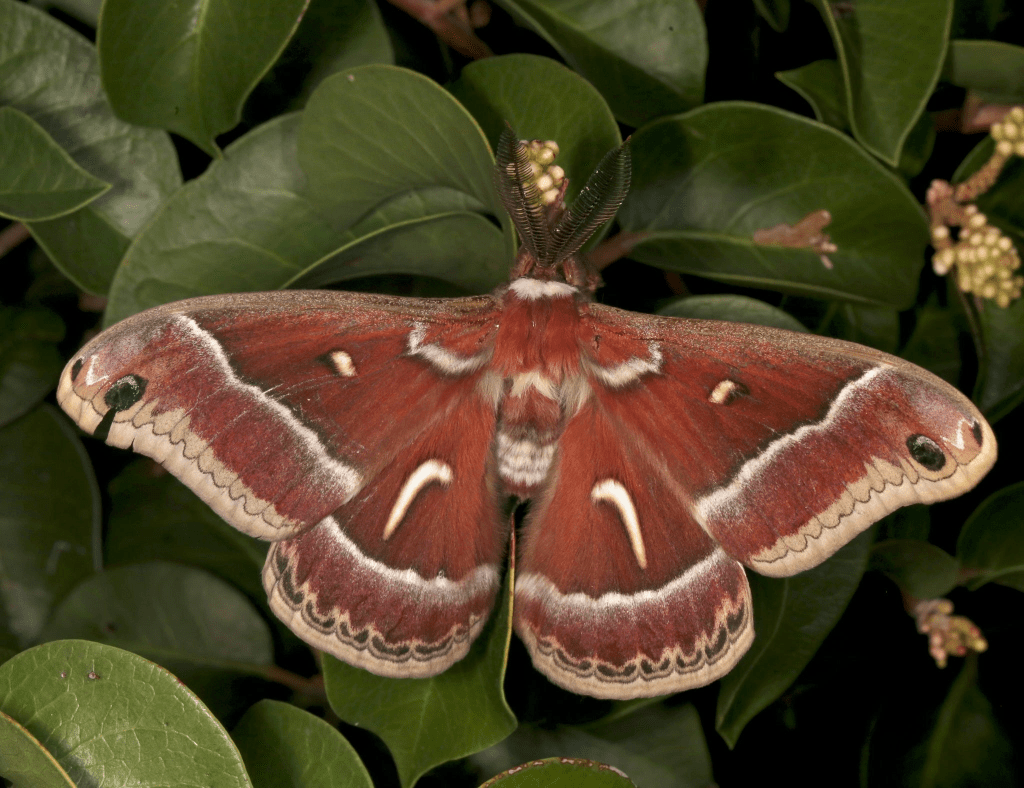
A magnificent Ceanothus silk moth on a Ceanothus plant (California lilac). Photo: Wikimedia
The Teaching Tree
Even the madrone’s leaves refuse to follow expectations. Tough and leathery, they are unappealing to most browsing animals; deer and elk usually pass them by. Yet after fire moves through the landscape, the madrone responds with fresh, tender shoots, and those same animals return to feed on new growth. It is a quiet reminder that resilience often shows itself after disruption.
For many Pacific Northwest tribes, including the Cowichan, Hoh, Saanich, and Salish peoples, the madrone has long been recognized not just for its beauty, but for its usefulness; its leaves were traditionally used as a dressing for burns, offering care and healing where the land itself had been wounded. In this way, the Pacific madrone stands as a teacher. Of adaptation, of renewal, and of the wisdom held by those who have paid close attention for generations. A tree that sheds its skin, feeds the forest in winter, and offers healing after fire feels less like an exception to the rules, and more like an invitation to rethink them.
Lessons in Renewal from a Rule-Breaking Tree
As the year turns, we often feel pressure to make clean breaks and bold resolutions. The Pacific madrone offers a gentler model. It doesn’t change on the expected schedule, doesn’t follow the usual rules, and doesn’t rush its transformations. Instead, it sheds when it needs to, reveals fresh layers slowly, and finds ways to nourish others even in the leanest seasons. As you reflect on the year ending and the one beginning, let the madrone be a guide. I don’t mean toward perfection or speed, but toward honest renewal, quiet resilience, and trusting your own timing. I invite you to peel back the layers of your year with the following prompts to journal about or reflect on with yourself or your family.
On Shedding and Renewal
- Like the madrone shedding its bark in summer, what layer of the past year are you ready to let fall away?
- What part of you feels newly revealed as this year ends; still tender, still forming, but real?
- What did you outgrow this year, even if it didn’t happen on a neat timeline?
On Rule-breaking and Identity
- Where did you quietly break the “rules” this year? Consider expectations, routines, or assumptions about who you’re supposed to be.
- What convention no longer fits you as you step into the new year?
- How has being a little unconventional helped you survive or thrive this year?
On Resilience Through the Dumpster Fire that Was 2025
- What was the “fire” of this year for you? Was there disruption, loss, or change? What new shoots are already beginning to grow?
- Where did tenderness return after something hard moved through your life?
- What surprised you about your own ability to respond after difficulty?
On Endurance and Strength
- Like the madrone feeding others in winter, where did you keep showing up even when resources felt low?
- What kind of strength did this year ask of you? Was it loud and visible, or quiet and steady?
- What does resilience look like for you right now, not in theory but in practice?
On Your Inner Wisdom and Looking Forward
- If the Pacific madrone were your teacher for the coming year, what lessons would you carry with you?
- What expectations are you ready to rethink as you step into the new year?
- What would it look like to trust your own timing, even if it doesn’t match the calendar?

 The Mindful Naturalist
Leave a comment