As the next Total Lunar Eclipse occurs on March 3, 2026, this eclipse season reminds us that extraordinary change often happens not from constant motion, but at life’s intersections.
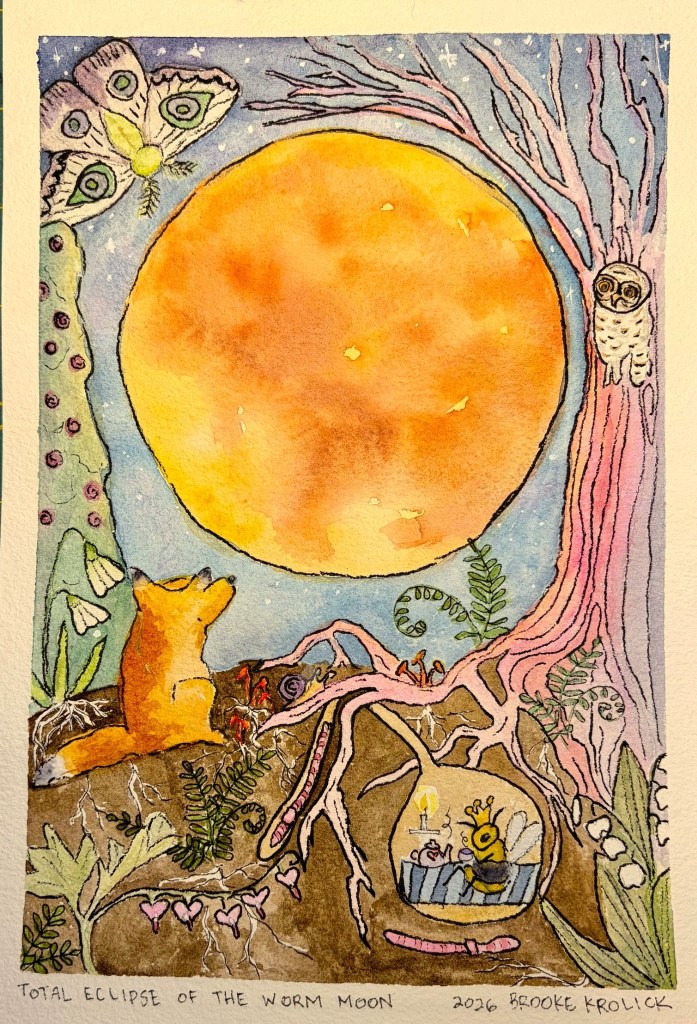
Turn around, Bright Eyes and look up! Here comes the Total Eclipse of the Worm Moon. Watercolor illustration by the author.
At first glance, eclipses seem like they should be ordinary. The Moon circles the Earth every 29½ days. There is a new moon each month and a full moon two weeks later. If alignment were simple, eclipses would be as common as turning calendar pages.
But the sky asks for more precision than that.
All About that Tilt
Eclipses occur only when the Sun, Earth, and Moon line up in a near-perfect straight line, an alignment astronomers call syzygy (and are lucky enough to regularly get to use that incredible word in a sentence). Even then, most months the Moon slips above or below the necessary line of alignment for an eclipse to happen. That is because the Moon’s orbit is tilted about five degrees relative to Earth’s orbit around the Sun. The two orbital paths intersect at two points in space called the lunar nodes. There’s an ascending node and descending node. Only when a new or full moon occurs near one of these nodes does the shadow truly fall.
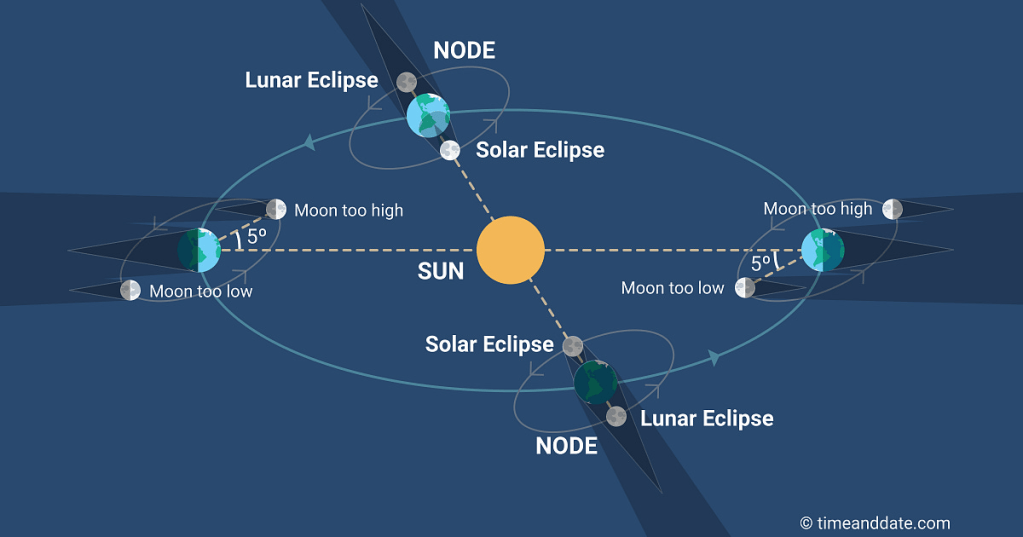
Image from “How Often Does a Solar Eclipse Happen” on TimeandDate.com
Those brief windows, when the Sun is close enough to a lunar node for alignment to occur, are what we call eclipse seasons. They arrive roughly every six months and last about a month. During that time, the geometry works. The gates are open. At least two eclipses unfold, one solar, one lunar, separated by about two weeks. The rest of the year, the alignment simply isn’t there.
There is something quietly humbling in that.
The lunar nodes are invisible. You cannot see them through a telescope. They are points of intersection. Crossroads where paths meet. Eclipse season reminds us that extraordinary change often happens not from constant motion, but at intersections. At crossings. At the places where different cycles overlap.
This window of possibility that we call eclipse season is a roughly month-long period that arrives about every six months, when the Sun, Earth, and Moon align closely enough for eclipses to occur. Typically, we experience two eclipse seasons each year; one in late winter or early spring, another in late summer or early autumn. During these seasons, at least two eclipses will unfold, separated by about two weeks: one solar at the new moon, one lunar at the full moon. This pairing reminds us how quickly shadow follows light, and light returns again.
Eclipse season offers an invitation:
Where in your life are you at a node or a crossing point?
What patterns are intersecting?
What shadow might briefly pass across something you thought was constant?
To explore this concept further with your young naturalist, try out The Exploratorium’s awesome activity, Eclipse in a Cup, using playdough and stacking cups.
Total Eclipse of the Worm Moon
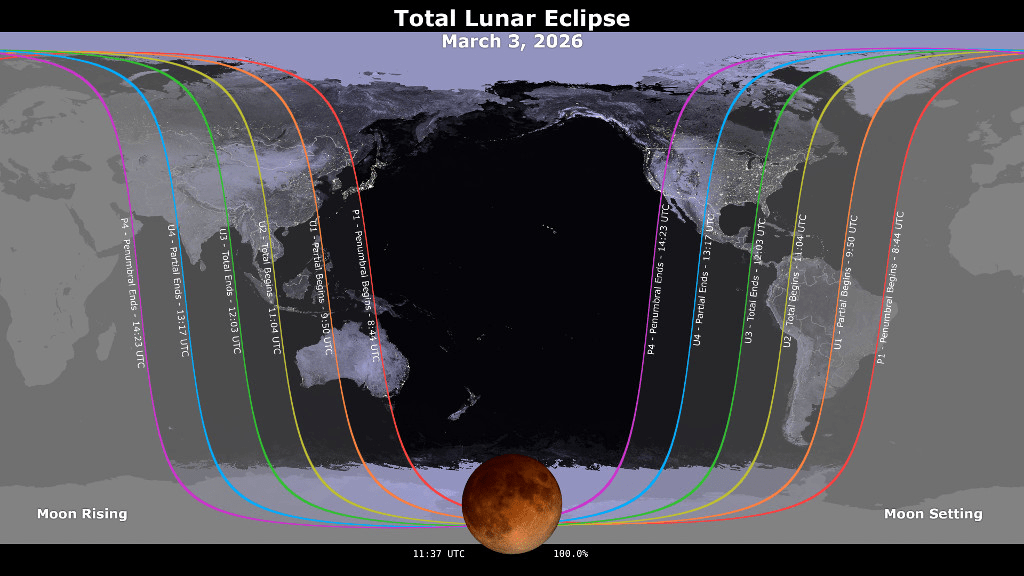
A map showing where the March 3, 2026 lunar eclipse is visible. Contours mark the edge of the visibility region at eclipse contact times. The map is centered on 170°37’W, the sublunar longitude at mid-eclipse. Image from NASA
February 17, 2026 brought an annular solar eclipse, also known as a ring of fire eclipse, that is fully visible only in Antarctica. You are statistically unlikely to catch that solar eclipse; however, two weeks later, on March 3, 2026, a total lunar eclipse will take place which will be visible from North America, Australia, New Zealand, Asia, and the Pacific. The Pacific Northwest will enjoy maximum visibility of the Blood Moon (as long as the weather cooperates). Totality will last about an hour and when the Moon is completely immersed in Earth’s umbral shadow, it will transform to a deep coppery blood-red color. On the West Coast of North America, we’ll set our alarms for 3:00 am, with peak color expected at 3:33 am.
The Moon looks pink or red during a total lunar eclipse because Earth blocks the Sun’s direct light and filters it through our atmosphere. Shorter blue wavelengths scatter away (this is the same reason our daytime sky is blue), while the longer red and orange wavelengths bend around the edges of the planet and continue onward into Earth’s shadow. This phenomenon, known as Rayleigh scattering, effectively gathers the colors of every sunrise and sunset happening around the rim of Earth in that moment and casts them onto the lunar surface.
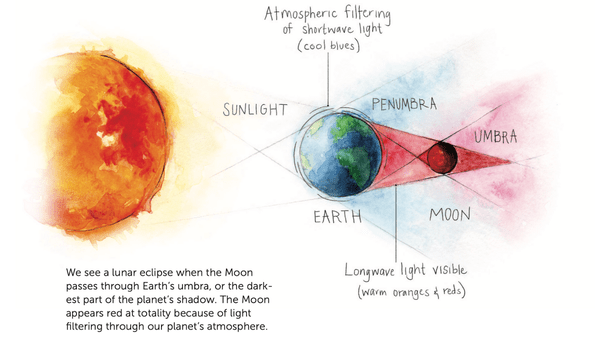
Image from Mountaineers taken from Dennis Mersereau’s Book The Skies Above: Storm Clouds, Blood Moons, and Other Everyday Phenomena
In other words, during a total lunar eclipse, the Moon is illuminated by the combined glow of all the world’s dawns and dusks at once.
If you could stand on the Moon during totality and look back at Earth, you wouldn’t see a dark planet. You would see a black disk surrounded by a thin, radiant ring of fire. A continuous halo of sunrises and sunsets encircling the globe. That ring is what lights the Moon red.
It’s astonishing to consider what that means.
Every dusty desert dawn.
Every ocean horizon dissolving into gold.
Every city skyline washed in amber.
Every quiet farmhouse dusk.
All of it refracted, braided together, and laid gently across the Moon.
The color of a lunar eclipse even carries information about us. Volcanic eruptions, wildfire smoke, and atmospheric pollution can deepen the red or dim the brightness. The Moon becomes another kind of mirror, not only reflecting the sun’s light, but the current state of Earth’s atmosphere as well. In that sense, a lunar eclipse is not just about shadow, it is about connection. The Moon glows because of us.
There’s something deeply moving in that idea. When Earth’s shadow falls across the Moon, it doesn’t extinguish the light. It transforms it. The very atmosphere that makes life possible, that softens sunlight, that scatters blue sky above us and paints evening gold, becomes the source of the Moon’s glow.
Even in shadow we are radiant.
Because during a total lunar eclipse, the Moon is not losing light.
It is holding all of ours.
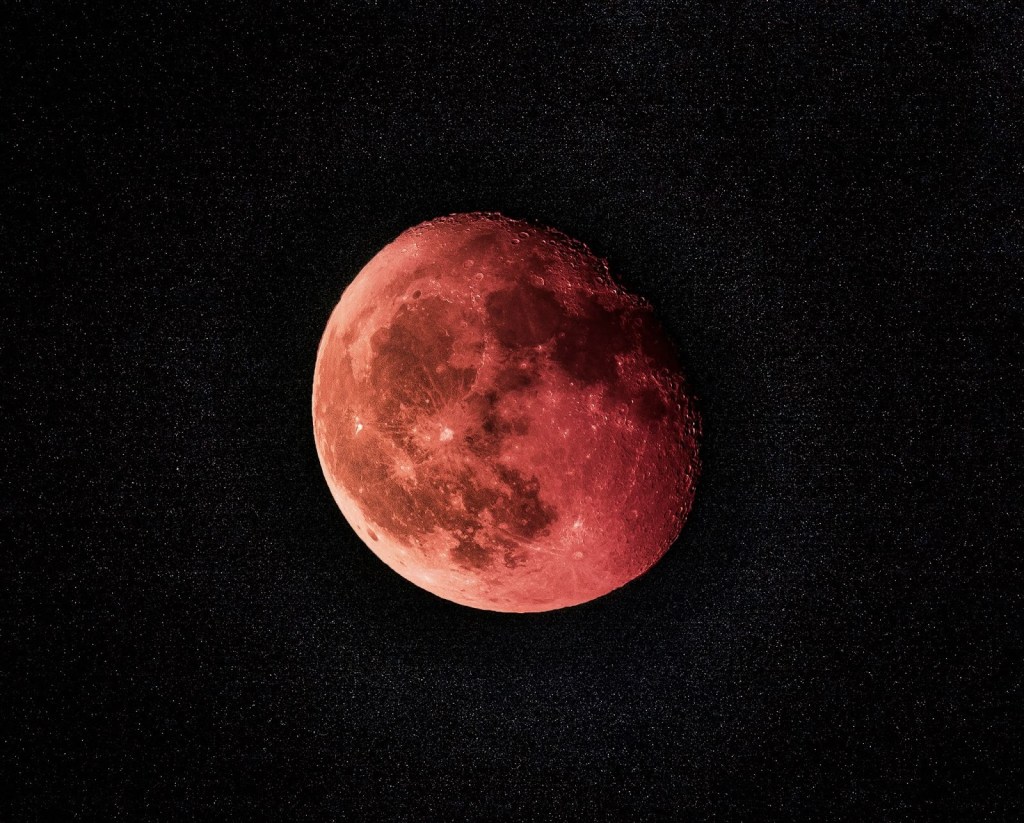
Image of moon during a total eclipse like the one we have coming up on March 3, 2026 by Zoltan Tasi from Unsplash
Sources and resources for further exploration
https://www.exploratorium.edu/eclipse/eclipse-stories-from-around-the-world
https://svs.gsfc.nasa.gov/5606
https://www.mountaineers.org/blog/lunar-eclipses
https://www.skyatnightmagazine.com/news/solar-eclipse-17-february-2026
https://www.nesdis.noaa.gov/annular-solar-eclipse
https://www.timeanddate.com/eclipse/how-often-solar-eclipse.html

 The Mindful Naturalist
Leave a comment