This essay is part of a new spotlight series called Rooted Lives. It is a series honoring the individuals whose lives and work have taken root in the Pacific Northwest, and beyond, shaping landscapes, communities, and the ways we learn to notice, care for, and belong to the natural world.
“What can I do to help?”
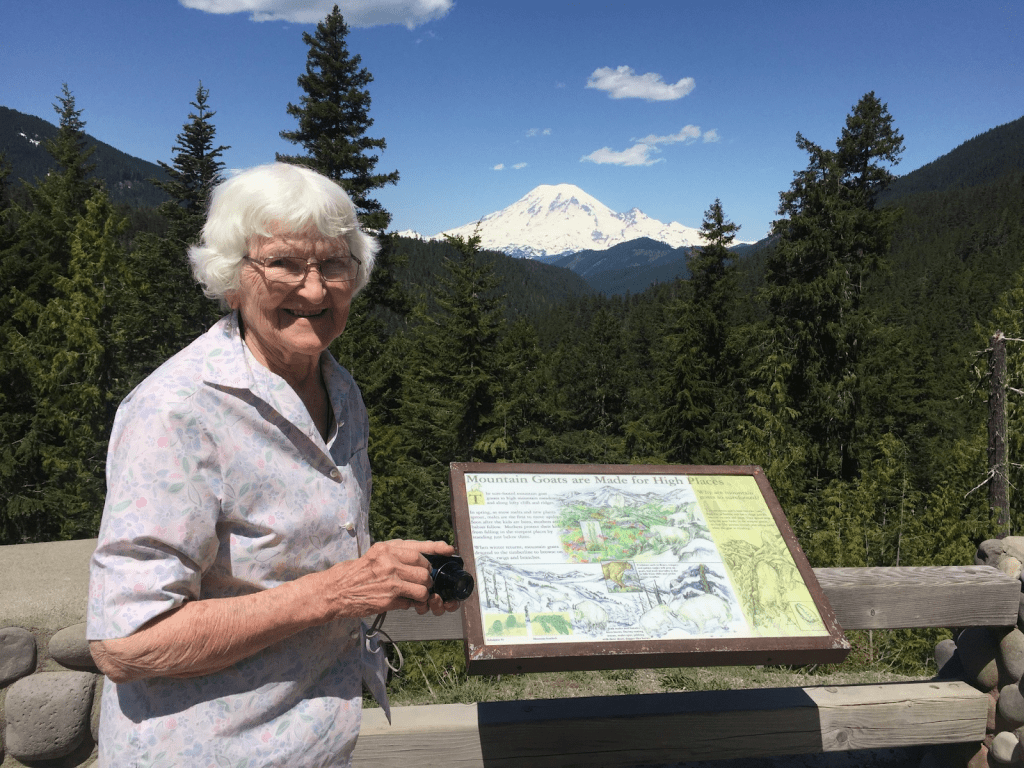
Helen Engle spent a lifetime answering that simple question. She worked tirelessly to create lasting protections for wetlands, shorelines, and wildlife habitat in the south Puget Sound region of Washington State. With a legacy that benefits both people and nature, Mrs. Engle (1926 – 2019) was a distinguished conservationist and activist. Born and raised in Grays Harbor county on a plot of land homesteaded by her great-grandfather in 1871, she trained as a nurse, and was mother to seven children, but found her true calling in environmental activism.
I didn’t know Mrs. Engle long, but I’ve been living with that central question – what can I do to help? – ever since I heard it used to describe her life.
In 2014, after returning to Seattle from a decade abroad, I happened to move in next door to her youngest daughter, Melanie. Our friendship began over a shared love of live music (Seattle made sharing that easy) but it deepened through shared time outdoors. Through Melanie, I came to know Mrs. Engle, if only briefly, before she passed.
Mrs. Engle believed that nature wasn’t something distant or reserved for wilderness areas, it lives in the places that we already call home. Her work helped establish urban and suburban green spaces, making nature accessible to families and neighborhoods while bringing together an unlikely coalition of birdwatchers, community groups, outdoor enthusiasts, and even loggers. Her impact was both practical and philosophical; she showed us that conservation begins not far away, but right where we stand.
She was the co-founder of the Tahoma Audubon Society in 1969, and one of the primary instigators of establishing the Billy Frank, Jr., Nisqually National Wildlife Refuge in South Puget Sound and the Grays Harbor Wildlife Refuge near her childhood home. Her appetite for learning and talent for uniting people led her to become a founding member of several leading Washington state conservation organizations including the Washington Environmental Council, Washington Wilderness Coalition, The Arboretum Foundation, Nisqually Land Trust, and Citizens for a Healthy Bay in Tacoma. If you’ve ever walked among the Old Growth giants at Point Defiance Park in Tacoma, you have Helen Engle to thank for personally and doggedly pursuing the Pierce County Metropolitan Parks Department until saving them from the literal chopping block. Her influence was further felt across the country as she served on the Board of the National Audubon Society for 20 years (1980–2000). Her activism included not just protecting land, but building communities, educating people about nature, and advocating across political lines.
At her memorial, what struck me most was not just the scale of her accomplishments, but the stories of her energy and determination. The many small, everyday ways she continued to show up for wildlife and community while raising seven children.
I couldn’t stop thinking about that. The raising seven children while changing the conservation landscape of Washington State’s south Puget Sound for the better part. I sat with it for weeks.
As a single parent of one, there are days when simply keeping us fed, bathed, and upright feels like all I can do. And yet, she did all of that, times seven. And then did some more. She cultivated a love of nature and a commitment to justice not in spite of her responsibilities, but alongside them.
That realization stayed with me. It marked a turning point. A moment when I began to think more intentionally about how I use my own sphere of influence as a parent and an educator. How I might invite the young people in my life to step into their own relationships with the natural world.
Her work also invites us to rethink where “nature” lives. It asks us to look closer. To the birds nesting in street trees, the moss softening a cracked sidewalk, the seasonal shifts in a neighborhood creek or schoolyard garden. By valuing these ordinary, nearby places, she showed us that meaningful relationships with the natural world don’t require special gear, long drives, or pristine landscapes. Nature is present wherever life persists, and when we learn to notice and care for it close to home, we build a deeper sense of belonging, stewardship, and shared responsibility for the places we already inhabit.
Helen Engle’s life is a reminder that meaningful change doesn’t require perfect conditions or unlimited time. It begins by starting where you are, with what you have, and choosing, again and again, to care for the places and people around you.

 The Mindful Naturalist
Leave a comment