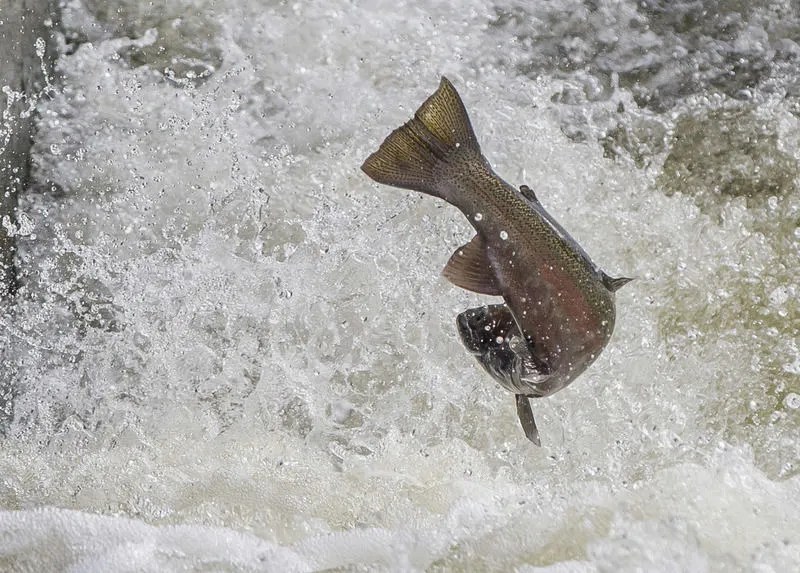
TLDR: Their journey is not fast or flashy; it is steady, patient, and stubborn.
Two Lives; One Fish
Oncorhynchus mykiss are fish with more than one way to grow up.
They begin life the same way every Rainbow trout does. They are hatched from tiny eggs tucked into cool, clean gravel at the bottom of fast-flowing rivers and streams. The water here is cold and rich with oxygen, just what young fish need to survive. But after that, Steelhead face a choice shaped by their surroundings. Some stay in freshwater forever, living their lives as Rainbow trout in freshwater lakes and streams. Others feel a different pull. They follow the river downstream, out to the ocean, and become Steelhead.
(An excellent video from the California Department of Fish and Wildlife explaining how Oncorhynchus mykiss can become either Rainbow trout or Steelhead can be found here: https://www.youtube.com/watch?v=qMtMXxFhaMA&t=66s)
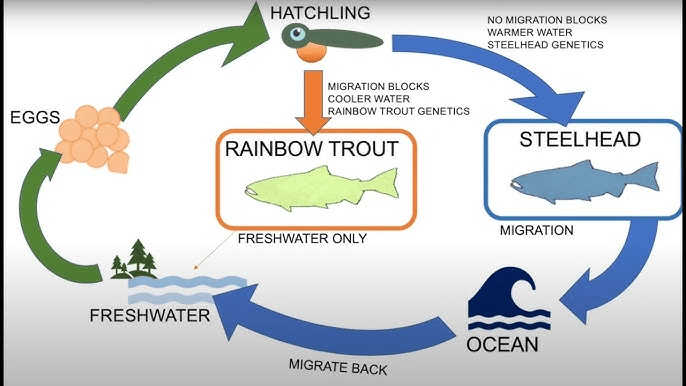
Image: California Department of Fish & Wildlife
The ocean is a place of plenty. Food is abundant, and Steelhead grow large and strong there, their bright freshwater colors changing to a silvery, metallic sheen, like polished steel. When the time is right, they turn around and swim back the way they came, pushing upstream through currents and rapids to return to the rivers where they were born. There, they spawn, which is another way to say that they are laying and fertilizing eggs to begin the cycle again.
Many kids in the Pacific Northwest first meet this life cycle through the Salmon in the Schools program, watching tiny eggs become wriggling hatchlings and learning how they make their return journey from the sea to the river of their birth where their life cycle ends. Here’s what makes Steelhead especially remarkable: unlike most Pacific salmon, Steelhead don’t die after spawning. Many survive the journey, slip back to the ocean, and return again in later years to spawn more than once. Because of this, Steelhead can live up to 10 years or more, traveling between rivers, estuaries, and the sea, using nearly every part of a river system along the way.
Image: TroutMastery.com

Steelhead runs (the name for when ocean going fish return to the river of their birth) happen at different times of year and are named for the season of their return to freshwater. Some are summer-run Steelhead, returning to freshwater in the summer months (May-October) as sexually immature fish. They hold in cool pools for months, maturing, and growing stronger. They then spawn later in the winter and early spring (December-April) when rains increase water flows and the water temperatures are just right for their eggs to be laid safely. Others are winter-run Steelhead, arriving closer to spawning time, often during storms when rivers run high and fast. Wild winter Steelhead can be found in Pacific Northwest rivers from late fall through early spring, strong and well-adapted to cold, rushing water.
Winter Steelhead arrive when the river is at its most challenging. It’s cold, swollen and loud with rain and snowmelt, rushing by with a thunderous roar. While other fish wait for gentler seasons, winter-run Steelhead move upstream through floodwater and debris, spending precious energy to reach spawning grounds that are often closer to the ocean but no less demanding. Their journey is not fast or flashy; it is steady, patient, and stubborn. Unlike salmon that give everything in a single, final effort, Steelhead may survive to spawn again, carrying the memory of past journeys in their bodies. Watching or learning about winter Steelhead invites us to rethink endurance, not as dramatic heroics, but as the quiet choice to keep going when conditions are hardest, to move forward slowly with patience, conserving strength, trusting that persistence through the rough season matters.

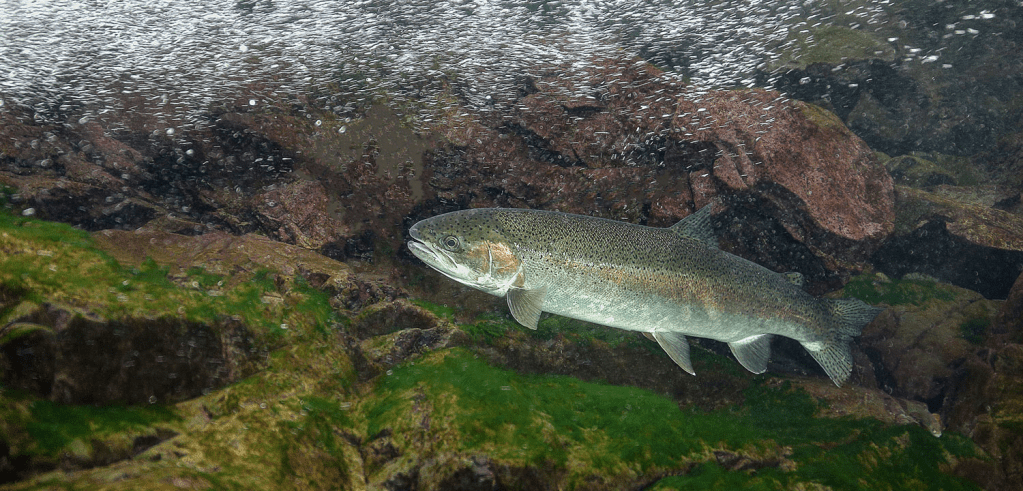
Image: Hudson Barboa, Unsplash
Even though Steelhead embody so much flexibility, they face many challenges. Roads, dams, culverts, and poorly designed stream crossings can block their paths, cutting them off from the places they need to reach. Changes to land and water (like warmer temperatures, lower stream flows, or muddy runoff) can make rivers harder to survive in. Steelhead may be adaptable, but they still depend on healthy, connected waterways.
Because their numbers have declined in many places, Steelhead are considered a Species of Greatest Conservation Need. This is a designation for wildlife facing population declines or threats that require focused conservation efforts in the US. Their story reminds us that rivers are not just places water moves through. They are living pathways. When rivers are free and healthy, Steelhead can choose their own way forward. When they are not, even the most resilient travelers struggle to return home.
Activity: Take an “Adopt-a-Creek” Walk
Visit a local stream or river and quietly observe. Look for signs of fish habitat: shade, gravel, insects, fallen logs, or clean flowing water.
- Nature Journal Prompts:
- Sketch or paint a “landscape-ito” or tiny landscape in your nature journal of what you see around you. Don’t worry about details, try to capture general shapes, textures, and colors.
- Create a sound map. Sit farther than arms length from any other person, close your eyes, and listen silently while sitting completely still for 2 minutes. Then open your eyes, but remain still and silent and draw a sound map for the next 3 minutes. A sound map is a blank piece of paper with an X in the center marking the person drawing the map and a small mark for each sound you hear in the rough direction and distance from the X. The mark should signal what the sound was (a bird beak for bird call, wavy lines for wind, tree leaves for rustling, etc…) The marks should be simple and quick to draw. When the time is up, compare your drawings with others in your group.
- You can learn a lot about physics by throwing rocks in a river!
- Do a beach clean up: Bring gloves and garbage bag with you to clean up any trash you find by the stream. Fishing line left behind by anglers can pose a particular risk to wildlife who may get caught up in it.
Extension Activity:
Journal Prompt Reflections: Reflect on the winter Steelhead’s journey upstream during the time of year that is the most challenging to do so. “Watching or learning about winter Steelhead invites us to rethink endurance, not as dramatic heroics, but as the quiet choice to keep going when conditions are hardest, to move forward slowly with patience, conserving strength, trusting that persistence through the rough season matters.” Consider the following questions and record your answers in your journal.
- When have you kept going despite uncertainty or discomfort? What helped you continue?
- What has a difficult season taught you about your own adaptability?
- What would it look like to measure progress in patience rather than speed?
- What helps you rest and gather strength when things feel fast or hard?
Kid-friendly prompts to discuss or support kids in writing about:
- If you were a Steelhead, would you go to the ocean or stay in a lake or river as a Rainbow trout? Why?
- What part of you has grown stronger from practicing over and over, even when it felt tricky?
- Can trying again quietly or in a small way still count as persevering?
- What helps you feel calm and recharge when life feels busy or tricky?
- Can you notice ways that nature “rests”? How do seasons, trees, or animals show us that taking a break is part of life?
Sources:
https://www.fisheries.noaa.gov/species/Steelhead
https://wdfw.wa.gov/species-habitats/species/oncorhynchus-mykiss-Steelhead#conservation
https://www.nwf.org/Educational-Resources/Wildlife-Guide/Fish/Rainbow-Trout-Steelhead
https://www.fws.gov/media/freshwater-fish-america-steelhead-trout


 The Mindful Naturalist
Leave a comment