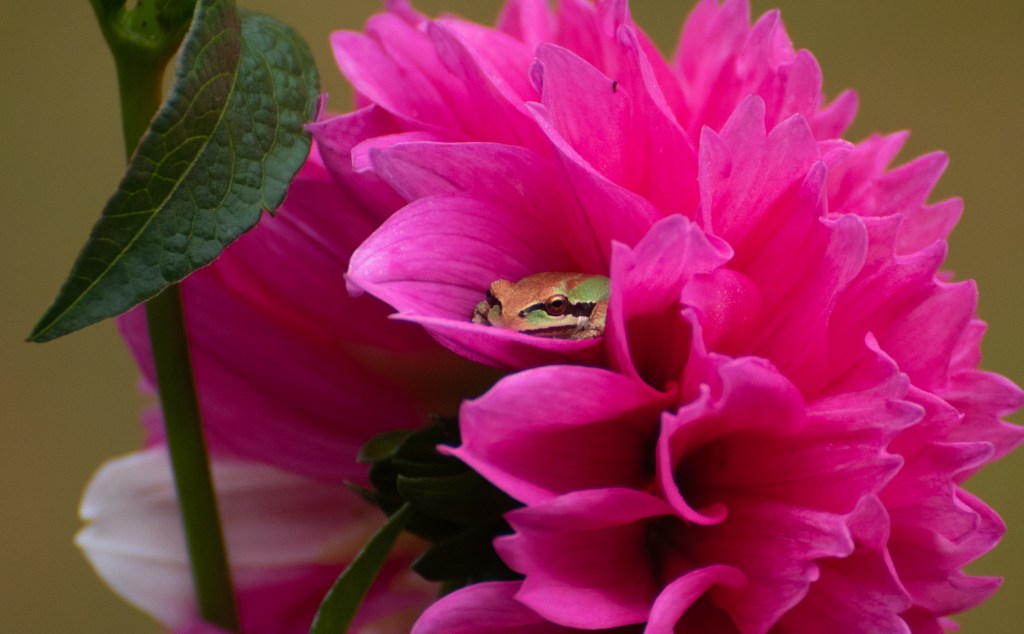
Cover photo: Pacific chorus frog resting in the cool shade of a late summer dahlia. Photo courtesy of my dear friend, Tom Bergeron.
Part of my seasonal field notes series, this introduction to Pacific chorus frogs offers a glimpse into what’s happening outside right now.
Isn’t it remarkable that the soundtrack of spring in the Pacific Northwest doesn’t come from birds? A chorus of tiny frogs calling out from puddles, ditches, and temporary ponds takes up center stage. Pseudacris regilla (if I’ve said it once, I’ve said it a thousand times, Pseudacris should be your next band name) the Pacific chorus frog, also known as the Pacific treefrog, may be small enough to fit on your thumb, but when they gather together, their voices can fill an entire landscape. They are the most abundant amphibian on the West coast of America and they can be found from British Columbia down to Baja California. They are commonly found in diverse habitats ranging from sea level to 10,000 feet! Their call, often described as a cheerful “ribbit,” is so iconic that it’s been used as the sound of frogs in movies and cartoons, even in places where this species doesn’t live.
The Mindful Naturalist is a reader-supported publication. To receive new posts and support my work, consider becoming a free or paid subscriber.
The hills are alive with the sound of Chorus frog music. Sound file, thanks to Tom Bergeron.
After spending the winter tucked away beneath leaf litter, logs, or loose soil, Pacific chorus frogs emerge with the return of longer days and warmer rains. During the colder months, they enter a state called brumation which is similar to hibernation, but for cold-blooded animals. Their bodies slow dramatically, their heart rates drop, and they rely on stored energy to survive until spring. In especially harsh conditions, these frogs have an almost magical ability: they can tolerate partial freezing, their bodies protected by natural antifreeze-like compounds. Specifically, for the nerdy among us, its high concentrations of glucose and glycerol that prevents them from succumbing to the freeze. This cryoprotection allows them to freeze solid, stopping their heart and breathing, then thaw and fully recover when temperatures rise.

Many Frogs, Hand-pulled screen print, 2014 by Roy Henry Vickers from BC’s Tsimshian Nation along the Pacific Northwest Coast. From the artist’s statement, “The frog is a powerful symbol of transformation for the Gitxsan people of the Skeena valley and has been a clan crest for thousands of years. There are dances and songs that belong to those people of the frog clan. One day I was inspired by some people of the frog clan to create this design for a large drum.”
When spring arrives, everything changes quickly. Males gather in shallow water and begin calling to attract females, inflating their dark throat sacs like tiny balloons. What follows is a burst of activity; eggs are laid in clusters, tadpoles hatch, and a whole new generation begins in a matter of weeks. These frogs depend on seasonal, temporary water sources and vernal pools that often dry up by summer, making their timing essential.
As the landscape shifts again toward heat and dryness, Pacific chorus frogs may enter another period of dormancy called aestivation. During aestivation, they seek out cool, moist refuges and become inactive to conserve water and energy through the dry season. It’s a different kind of stillness than winter’s brumation, but just as important for survival in a climate of extremes. Where I live in California’s Sierra Nevadas, I’m often startling the poor dears when I come by with the garden hose as they nestle into the cool shade of my plant pots to escape summer’s dry heat.
The lives of Pacific chorus frogs move in pulses. Quiet in winter, exuberant in spring, hidden again in summer. Their rhythm is tied closely to rain, temperature, and the fleeting presence of water. If you listen closely on a damp spring evening, you might hear their chorus rising all around you. A reminder that even the smallest creatures are responding, with perfect timing, to the turning of the seasons.
There’s something deeply grounding in the way the Pacific chorus frog moves through the year. They are not constantly active, not constantly striving, but responding with precision to the moment it’s in. A few quiet but powerful lessons emerge from that rhythm.
Lessons from a Pacific chorus frog
1. Life doesn’t have to be constant to be meaningful.
Chorus frogs remind us that growth and expression come in pulses. There are seasons for stillness, for hiding, for conserving energy. And seasons for showing up fully and making yourself heard. Our culture often pushes for nonstop productivity, but the frogs suggest that timing matters more than constant output.
2. Rest is not absence. It’s preparation.
Their quiet winter and hidden summer aren’t wasted time. Those periods of retreat make the explosive energy of spring possible. What looks like inactivity is actually essential. There’s a lesson here about trusting dormant phases in our own lives.
3. Respond, don’t force.
Chorus frogs don’t try to sing in the wrong season. They wait for the rain, the right temperature, the right conditions and then they respond completely. There’s wisdom in aligning with what’s actually happening, rather than pushing against it.
4. Small voices, together, create something powerful.
One frog is easy to miss. A chorus is impossible to ignore. Their collective sound reminds us that even small contributions matter, especially when joined with others.
5. Timing is its own kind of intelligence.
The frogs don’t overthink their moment, they feel it. When the conditions are right, they act. It’s a reminder that not all knowing is intellectual; some of it is instinctual, embodied, and deeply connected to the world around us.
6. The “window” won’t stay open forever and that’s okay.
Their breeding season is brief and tied to fleeting water sources. Instead of resisting that impermanence, they meet it fully. There’s a gentle nudge here: when your moment comes, step into it. You don’t need endless time. Just bring your willingness to begin.
Taken together, the chorus frogs offer a different model of living. One that honors cycles, trusts timing, and embraces both quiet and expression as equally necessary parts of a whole.
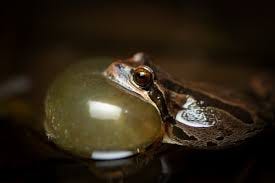
Singing Pacific chorus frog. Photo by Charlotte Gruneau. Find her remarkable work on instagram: cgwildlifephotography.
Life Cycle
The life of the Pacific chorus frog unfolds like a fleeting song shaped by water, temperature, and time. With the first warm rains of late winter or early spring, males gather at the edges of temporary ponds and quiet ditches, their calls rising into the damp evening air. Females arrive, and in the shallows they lay clusters of eggs, each one a small, translucent bead anchored to submerged plants. As male chorus frogs make advertisement calls, female frogs approach and select their mate. Eggs are carefully attached to submerged sticks or stones, anchored just long enough to complete their transformation. A single female chorus frog can lay 500 to 1,250 eggs in a year! Chorus frogs have a prolonged breeding season that can stretch several months in order to take advantage of available seasonal water and pools. Within days or weeks, depending on the warmth of the water, their eggs quicken and hatch into tiny, gilled swimming tadpoles who spend two to five weeks feeding, growing, and drifting in the safety of the water’s edge.
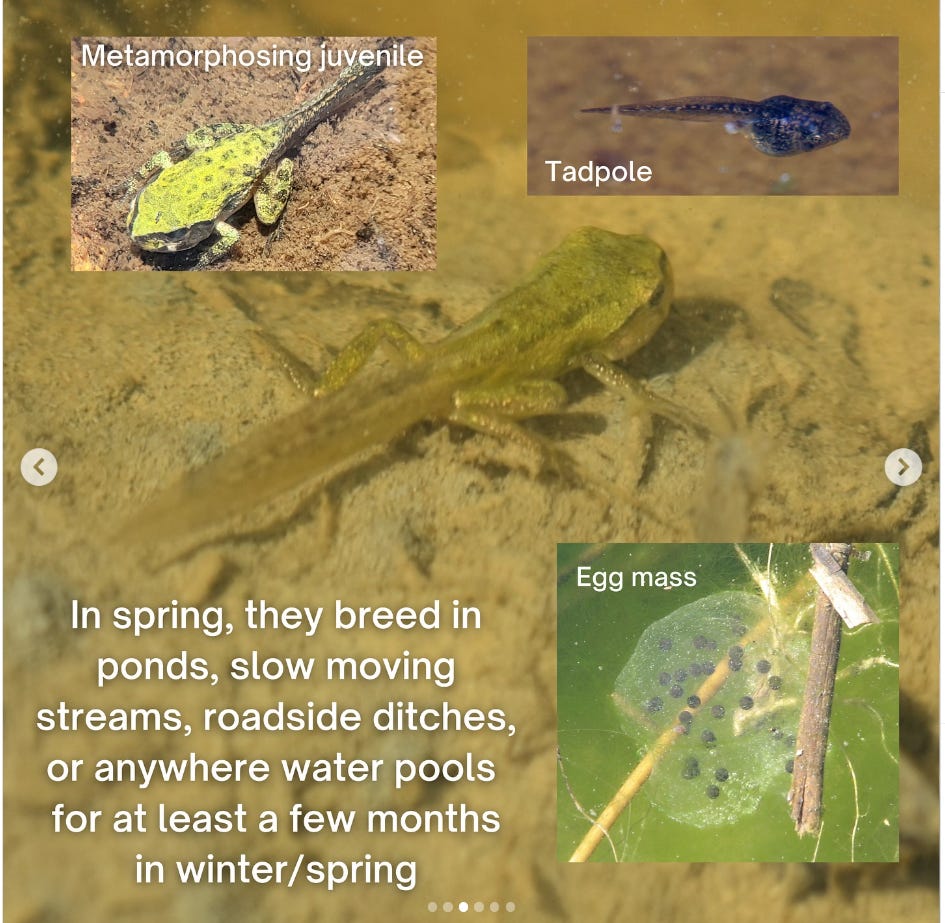
Explainer graphic from Symbio Op Garden Shop.
But these nurseries are temporary, and the clock is always ticking. As spring leans toward summer and the water begins to shrink, the tadpoles transform. Legs emerge, tails recede, lungs replace gills, and one by one they leave the water behind, no larger than a fingernail. The young frogs disperse into the surrounding grasses and leaf litter, beginning a mostly hidden life of foraging and growing. As the seasons turn, they slip into stillness when entering brumation during the cold months, and sometimes aestivation when the land grows hot and dry. Waiting, always, for the return of rain.
And then, almost as suddenly as they vanished, they return. The ponds refill, the air softens, and the chorus rises again. What was once a cluster of eggs becomes a voice in the night, part of a living cycle that pulses with the seasons. Brief, repeating, and perfectly timed to the rhythms of the earth.
Identifying Pacific chorus frogs
While their song is unmistakable, it may take some effort to spot one. When you do catch a glimpse, they are small and easy to overlook, usually no more than a couple of inches long, with a dark stripe running from the nose through the eye and along the side. They tend to stay close to water during breeding season, clinging to grasses or tucked among reeds, their presence revealed as much by movement as by form.
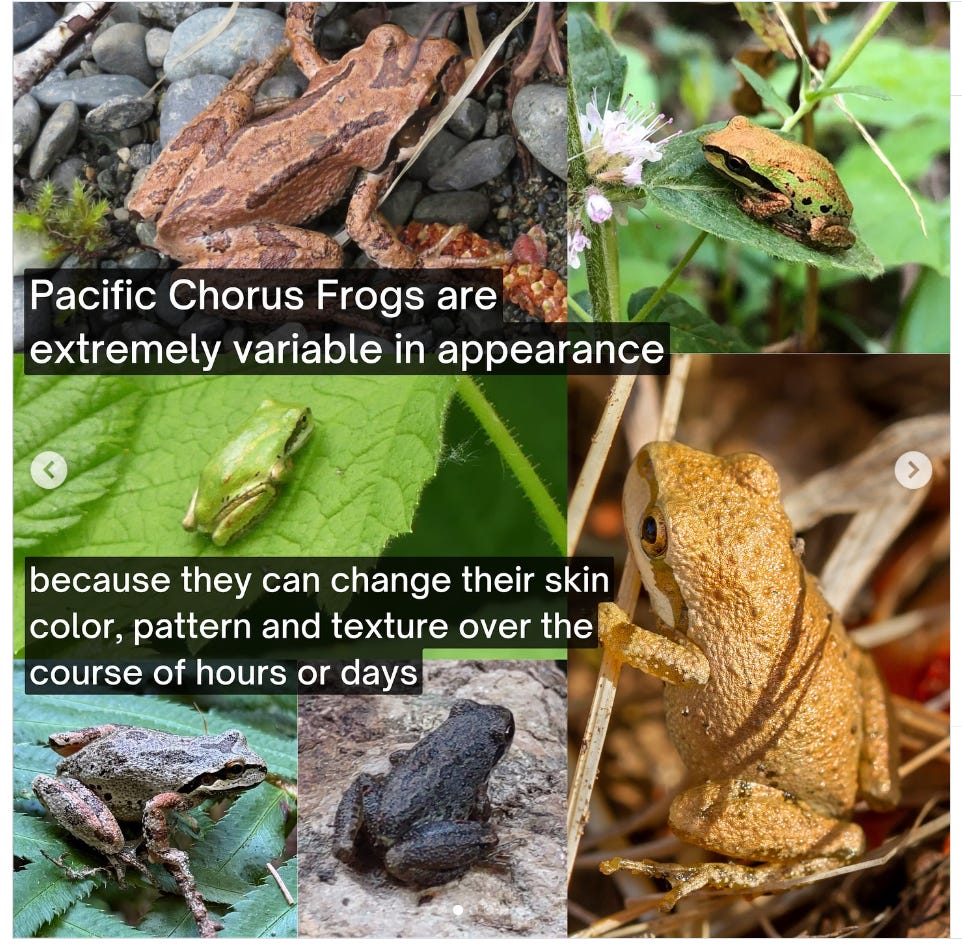
Explainer graphic from Symbio Op Garden Shop.
What makes them especially delightful to identify is their remarkable range of colors. While many are shades of green or brown, some individuals carry a reddish hue, and patterns can vary widely from frog to frog. This diversity is shaped in part by genetics. Studies have shown that multiple genes influence coloration, with brown tending to be dominant and red more recessive, but the story doesn’t end there. Pacific chorus frogs are also capable of shifting between green and brown depending on their surroundings, blending into leaves, mud, or bark with subtle ease. In this way, they are both constant and changing, a small, living reflection of the adaptable, ever-shifting landscapes they call home. If you’re not sure, look out for that eye stripe originating from just above the nostril and extending toward the front legs. That’s a diagnostic feature!
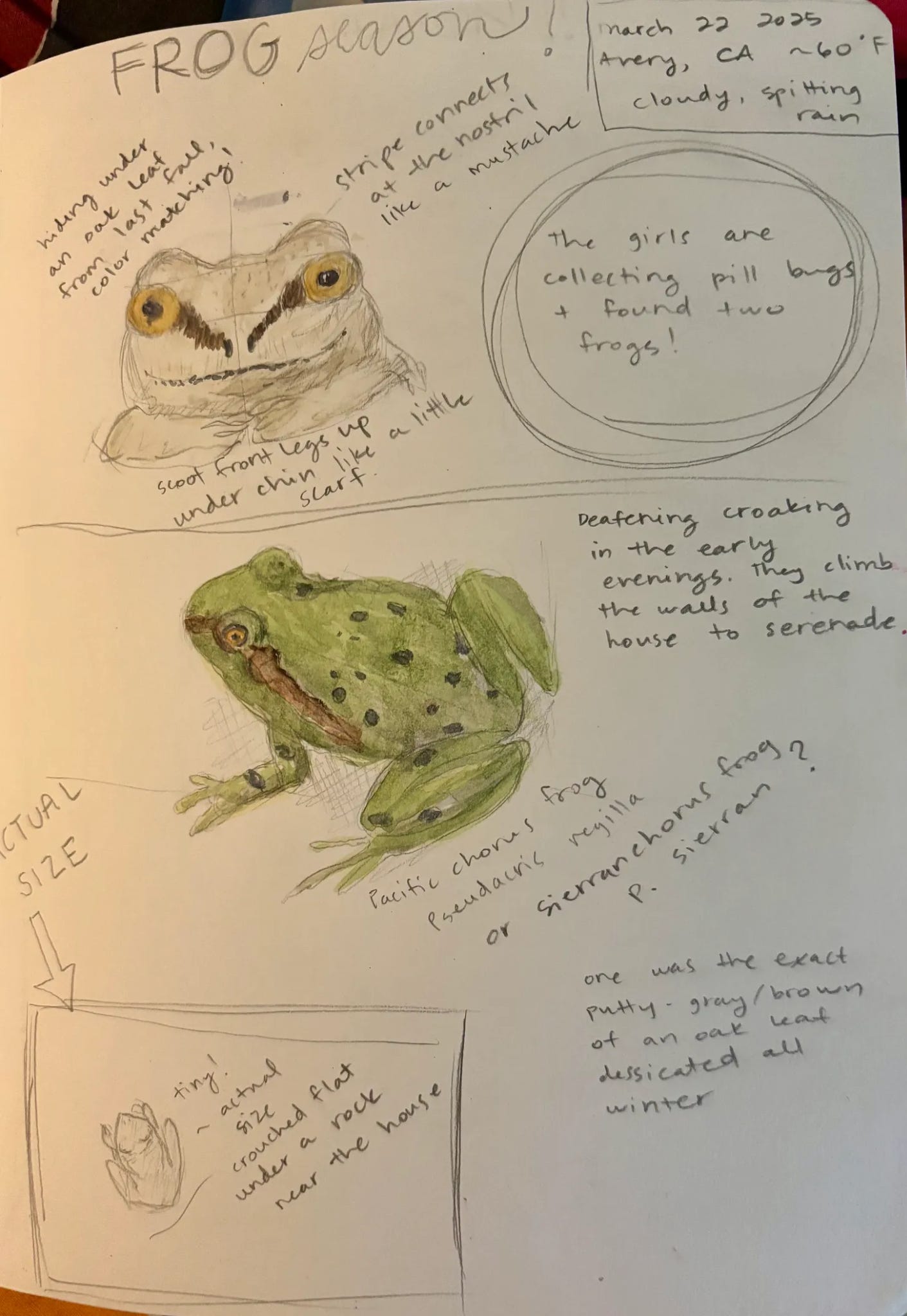
Page from my nature journal.
How can you help?
- To support these remarkable amphibians, consider leaving patches of natural habitat in your yard like leaf litter, native plants, or even a small seasonal water feature. Our backyard “pond”, a small, salvaged plastic tub, is teaming with frogs all summer and fall.
- Avoid using pesticides, which can harm frogs at every stage of life. Amphibians have highly permeable skin that can absorb toxic chemicals. They can be poisoned directly or indirectly through their food, such as slugs and snails. Moss and weed killers can also be toxic to amphibians and be aware that anything that you apply to your home or yard will be washed downstream into the watershed with the strong winter rains we see in the Pac NW.
- As long as we are talking about permeable skin, please wear gloves if you decide to handle a chorus frog. If we are picking up multiple frogs, it’s so easy to spread parasites or other harmful material to our frog friends. I’ll talk about it in a future post, but a fungal parasite has spread around the globe that endangers amphibians everywhere.
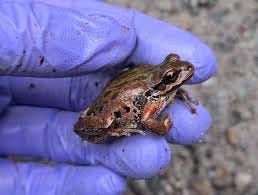
Wear gloves when handling frogs! And change them out between animals if you are handling multiple frogs!
- Also, never release a bullfrog or other non-native wildlife into the wild. Bullfrogs and pet turtles that have been released into neighborhood ponds are eating and out-competing our tadpole and frog friends.
- If you have enough space, retain stumps, logs, root wads, rock piles and other debris that provide a cool, moist habitat for amphibians. Such habitat features provide much needed cover and also attract the food sources that amphibians need to survive. Notice how once you have Chorus frogs nearby, you’ll have fewer pesky mosquitoes! Mosquito larvae is a froggy delicacy.
With just a little mindful care, you might find that your own backyard becomes a springtime symphony.
Sources and further information:
https://www.mister-toad.com/PacificTreeFrog.html

 The Mindful Naturalist
Leave a comment